Jumbunna 10th August 2023
117

A Message from Ken and Jayne
Communication with the Office
If you receive a missed call from the school we ask that you please check your voicemails before returning the call. Staff regularly contact parents and as your time is valuable it is helpful for the office staff to know which teacher you would like to speak to so we can quickly direct your call. Thank you for your assistance with this.
Student Late Arrivals
If your child is late of a morning you will need to sign them in at the office. This will ensure that attendance is up to date and in the event of an Emergency, your child will be accounted for.
Staff Car Park
Please be reminded that, due to safety reasons, the staff carpark is not to be used for parent parking or a thoroughfare at drop off or pick up time. The gates leading into the car park will be locked from 8:30am-3:45pm. Please use the gates that lead directly from the street into the school grounds. Our priority is to keep your children safe.
Helpful Hints for Parents in Term 3
Third Term is a tricky time of year, winter is dragging, children are getting tired and resilience and patience are waning. I have had the pleasure over the past few weeks of speaking to and emailing many of you to assist your children to navigate their emotions and struggles. As parents, we have all experienced the distress and worry it caused when our children are struggling. Many of the wonderful parents I have spoken to feel they have exhausted their pool of resources and have asked, “What can I do to help my child?” It is important, although hard, to build resilience in our children. Unfortunately, they need to experience the ups and downs of daily life to build skills and strategies which will equip them to thrive and succeed both now and in adulthood? I have sourced some resilience building tips from many resources and of course I don’t expect you to use them all, but have a read through and hopefully you will gain a few helpful ideas to try with your child. Remember that you are doing a fantastic job as a parent and please reach out if you need too.
Resilience is being able to bounce back from stress, challenge, tragedy, trauma or adversity. When children are resilient, they are braver, more curious, more adaptable, and more able to extend their reach into the world.
Building children into healthy, thriving adults isn’t about clearing adversity out of their way. Of course, if we could scoop them up and lift them over the things that would cause them to stumble, that would be a wonderful thing, but it wouldn’t necessarily be doing them any favours. A little bit of stress is life-giving and helps them to develop the skills they need to flourish. Strengthening them towards healthy living is about nurturing within them the strategies to deal with that adversity.
regards
Jayne
Here are some strategies to help build your child’s resilience:
- Increase their exposure to people who care about them. Social support is associated with higher positive emotions, a sense of personal control and predictability, self-esteem, motivation, optimism, a resilience. Let them know about the people in their fan club. Anything you can do to build their connection with the people who love them will strengthen them. E.g. ‘I told Grandma how brave you were. She’s so proud of you.’
- Let them know that it’s okay to ask for help. Children will often have the idea that being brave is about dealing with things by themselves. Let them know that being brave and strong means knowing when to ask for help. If there is anything they can do themselves, guide them towards that but resist carrying them there.
- Build their executive functioning. This will help them manage their own behaviour and feelings, and increase their capacity to develop coping strategies. Some powerful ways to build their executive functioning are establishing routines, modelling healthy social behaviour, creating and maintaining supportive reliable relationships around them, providing opportunities for their own social connections, encouraging creative play, playing board and memory games, exercise and providing opportunities for them to make their own decisions.
- Encourage regular mindfulness practice. Mindfulness creates structural and functional changes in the brain that support a healthy response to stress. See here for fun ways that children can practice mindfulness.
- Exercise strengthens and reorganises the brain to make it more resilient to stress. Get your child moving, throw a frisbee, kick a ball, give a hula-hoop a spin, walk the dog etc.
- Build feelings of competence and a sense of mastery. Nurture that feeling that they can do hard things, acknowledge their strengths, the brave things they do and their effort when they do something difficult. When they have a sense of mastery, they are less likely to be reactive to future stress and more likely to handle future challenges.
- Nurture optimism. Optimism has been found to be one of the key characteristics of resilient people. If your child tends to look at the glass as being half empty, show them a different view. Se here for more ways to nurture optimism in children.
- Teach them how to reframe. In times of difficulty or disappointment, reframing will help them to focus on what they have, rather than what they’ve lost. To build this skill, acknowledge their disappointment, then gently steer them away from looking at what the problem has cost them, towards the opportunities it might have brought them.
- Model resiliency
Imitation is such a powerful way to learn. Let your child see how you deal with disappointment, sadness and struggles as these are all very normal human experiences. When experiences are normalised, there will be a safety and security that will open the way for them to explore what those experiences mean for them, and experiment with ways to respond.
- Facing fear – but with support. Facing fear can be empowering when you feel supported. See here for the stepladder, which explains how to support your child gently and safely towards the things that challenge them.
- Encourage them to take safe, considered risks.
Let them know that the courage they show in doing something brave and difficult is more important than the outcome. Encourages them to think about their decisions, and teach them that they can cope with the things that go wrong. Don’t rush to their rescue but rather support and guide them if needed. Exposure to stressors and challenges that they can manage during childhood will help to ensure that they are more able to deal with stress during adulthood.
- Let them know that you trust their capacity to cope.
Show your child that you believe they have the ability to cope with the stumbles along the way and they will believe this too. This isn’t always easy. We will often feel every bump, bruise, fall or fail. It can be heartbreaking when they struggle or miss out on something they want, not because of what it means for us, but because of what we know it means for them. But – they’ll be okay.
- Build their problem-solving toolbox.
Self-talk is such an important part of problem-solving. Your words are powerful because they are the foundation on which they build their own self-talk. Rather than solving their problems for them, start to give them the language to solve their own. Help them break a big problem into little pieces and give them the problem-solving language without handing them solution.
- Let them talk.
Try to resist solving their problems for them, instead, be the sounding board. As they talk, their mind is processing and strengthening. Guide them, but wherever you can, let them talk and try to come up with their own solutions. You are the safest place in the world for them to experiment and try new things. Problem-solving is a wonderful skill to have, and their time talking to you, and coming up with ideas, will build it beautifully.
- Try, ‘how’, not ‘why’.
When things go wrong, asking kids ‘why’ will often end in ‘don’t know’. Who knows why any of us do silly things or make decisions that aren’t great ones. The only certainty is that we all do them. Rather than, ‘why did you paint your sister’s face?’ which might lead to the perfectly reasonable explanation of, ‘to make it yellow’, encourage problem-solving and reflection by asking how they can put it right. ‘She’s yellow but it’s not okay for her to stay yellow. How can you fix this?’
One of the most important tools in resilience building is something you are already doing, letting them know they are loved unconditionally. A big part of resilience is building their belief in themselves. It’s the best thing they’ll ever believe in.

Dates to remember

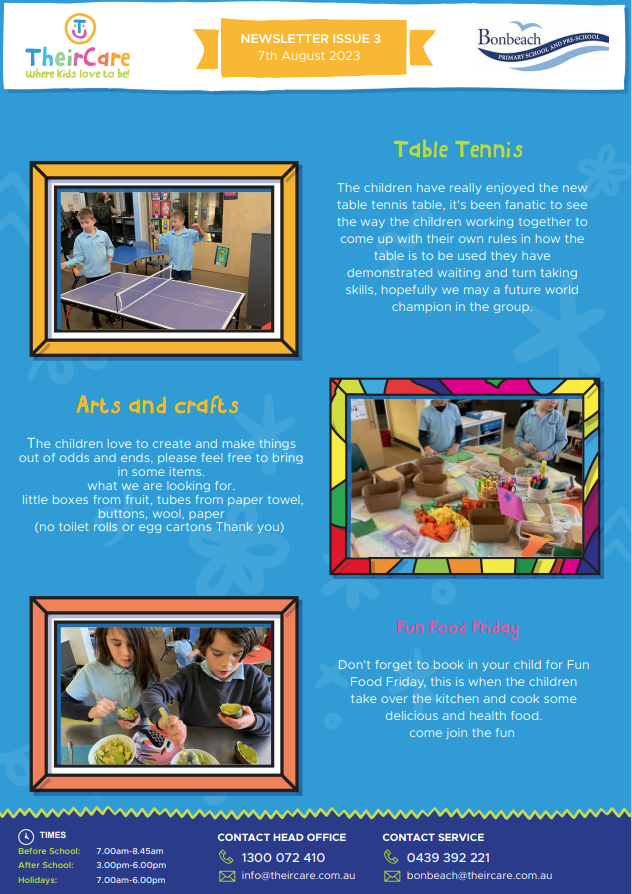
Theircare News

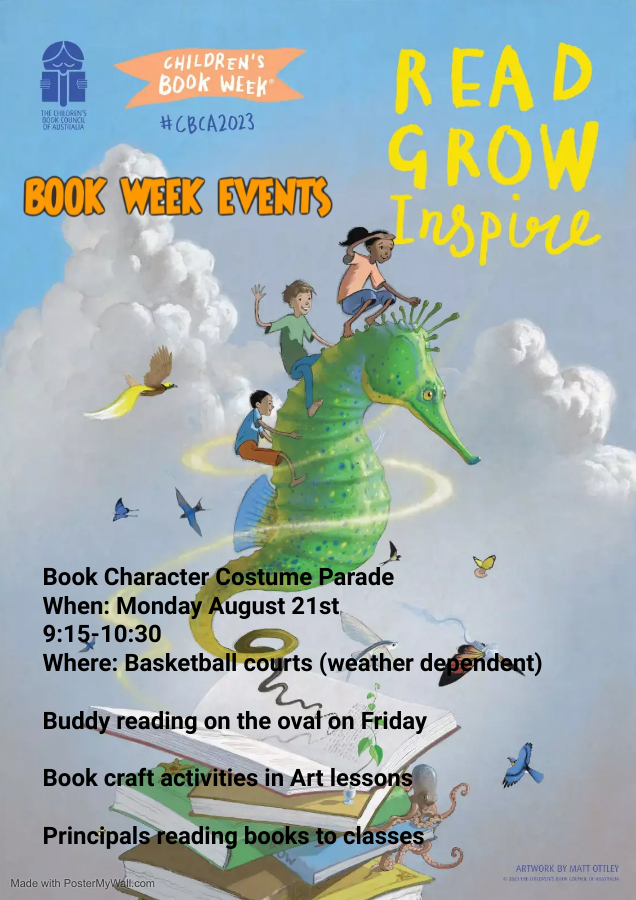
Book Week
Dear parents and guardians,
With book week approaching us, we are looking forward to celebrating and continuing to grow a love for reading. Book week will be celebrated in week 7 (21st of August - 25th of August). The parade will be held on Monday morning of Week 7 (Monday 21st of August) at 9:15am. We are hoping to hold the parade on the basketball and netball courts, depending on weather. Students will also be exploring book week activities during Visual Art that week.
We are looking forward to seeing your favourite books character come to life!
Millie Goray – 3/4 Teaching Team